Collection record · Neuroscience
Drawings of the nervous system
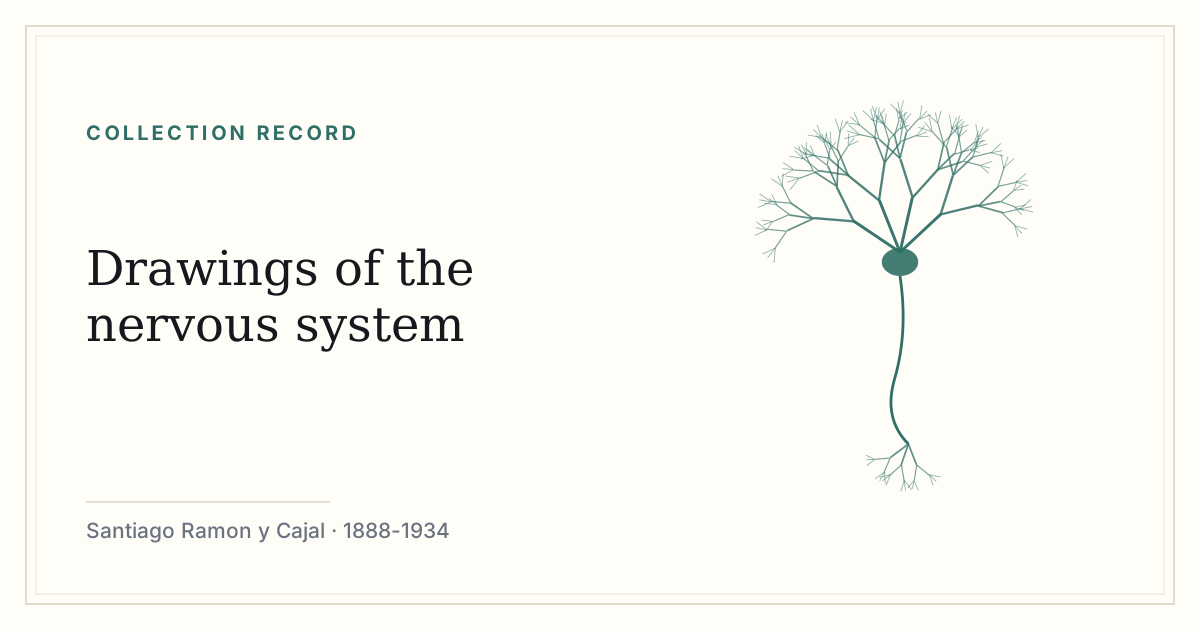
Around 2,900 ink and pencil drawings that established the neuron as a discrete cell — and asserted a gap no microscope of the period could resolve.
About this item
Santiago Ramón y Cajal encountered Camillo Golgi’s silver nitrate stain in 1887 and spent the following decades using and improving it. Golgi’s method works because it is capricious: it impregnates only a small, apparently random fraction of the cells in a preparation, rendering those few completely black against an empty field. Cajal developed a double-impregnation variant and, more importantly, chose his material shrewdly — young and embryonic tissue, where myelination is incomplete and processes are shorter and less tangled.
From these preparations he argued that nervous tissue is composed of discrete cells that approach one another closely but never fuse. This is the neuron doctrine, against Golgi’s reading of the same preparations as a continuous fused network. Cajal added a direction of flow — his law of dynamic polarization — in which signals are received by dendrites and leave along the axon. The two men shared the 1906 Nobel Prize in Physiology or Medicine and used their Nobel lectures to disagree.
The drawings themselves were not traced. Cajal studied a preparation over long periods, refocusing through its depth to follow processes, and then drew — often away from the microscope, sometimes combining features established across several preparations. Roughly 2,900 drawings survive in Madrid and are still used in teaching.
Why it is in the collection
Because these images are interpretations presented in the visual language of records, and the distinction is instructive rather than damning. Deciding which fiber continues where, once it leaves the plane of focus, is an inferential act. Cajal’s drawings assert a discontinuity between cells that the light microscopes of the 1890s could not resolve; the synaptic cleft was not shown directly until electron microscopy in the 1950s.
Golgi’s objection — that the apparent gaps were limits of the instrument — was the correct question to ask, and he was wrong. That is the useful lesson: the evidence available was compatible with both readings, and Cajal chose correctly on the strength of an enormous amount of careful looking.
Catalog record
- Record
- OSM-2026-004
- Title
- Drawings of the nervous system
- Creator
- Santiago Ramón y Cajal (1852–1934)
- Date
- 1888–1934
- Place of production
- Barcelona and Madrid
- Medium and technique
- Ink and pencil on paper, drawn from Golgi-stained histological preparations
- Extent
- Approximately 2,900 surviving drawings
- Original held by
- Instituto Cajal, Consejo Superior de Investigaciones Científicas (CSIC), Madrid
- Rights status
- Mixed, and worth checking per item. Cajal died in 1934, so the works are in the public domain in the European Union (life plus 70 years, expired 2005) and drawings published before 1929 are in the public domain in the United States. Some later material may remain restricted in some jurisdictions, and the Instituto Cajal applies its own terms to its digital reproductions.
- Digitized copies
- Instituto Cajal (CSIC), Madrid. Consult the catalog of the institution named above for the current scan. We add permanent item identifiers here as we verify them, and prefer an empty field to a link that rots.
- Record published
- 29 July 2026
- Rights last reviewed
- 29 July 2026
The rights status above describes the original work. A particular digital reproduction may be published by the holding institution under its own separate terms, which can be more restrictive than the status of the underlying work. Check the terms attached to the specific file you intend to use. We are not able to grant permissions for material we do not hold.
Read the essay: Drawings that were arguments.