Journal · Neuroscience
Drawings that were arguments
Santiago Ramón y Cajal’s pictures of nerve tissue are among the most reproduced images in biology. They are not transcriptions of what sat under his microscope, and understanding that is the point.
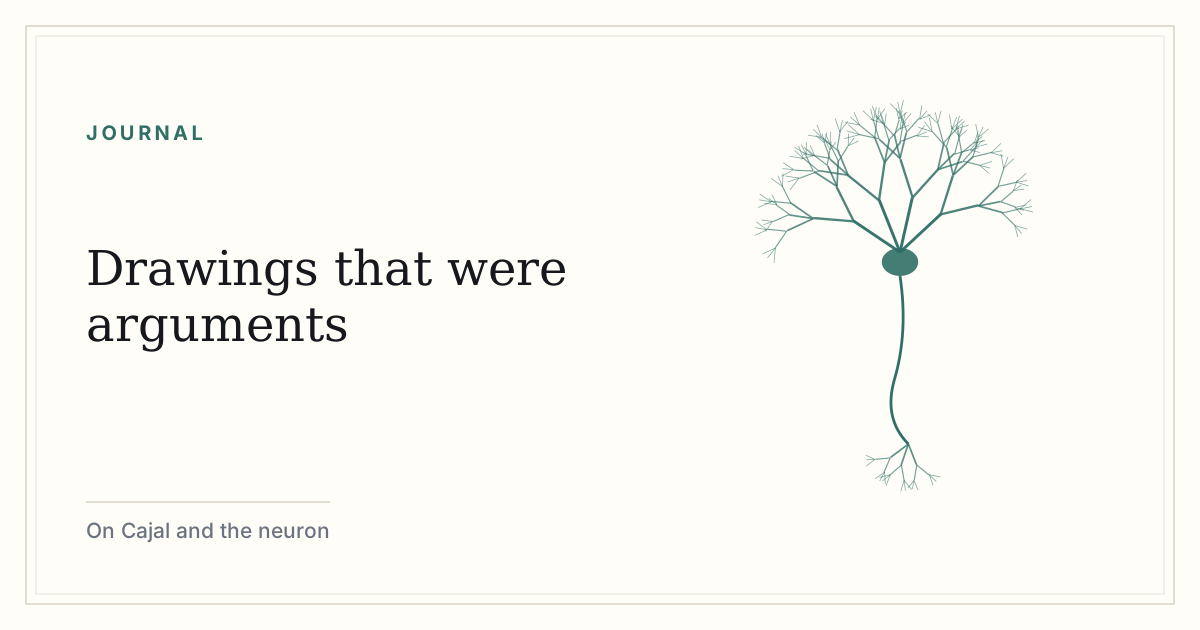
The problem with nervous tissue is that it is almost perfectly designed to defeat a microscope. Cells are packed at enormous density, their processes are thinner than the wavelength of visible light in places, and they are tangled together in three dimensions. Stain it all and you get a black block. Stain none of it and you get a gray block.
Camillo Golgi’s silver nitrate method, published in 1873, worked because it is unreliable. For reasons still not fully understood, the reaction takes in only a small and apparently random minority of the cells in a preparation, filling those completely and leaving their neighbors untouched. A handful of neurons appear in black, entire, against a clear background. It is a stain that works by failing most of the time.
Cajal encountered Golgi preparations in 1887, in Madrid, and recognized immediately what they were worth. He then spent years improving the method — a double impregnation that gave denser, more consistent fills, and, crucially, a choice of material: young and embryonic tissue, where myelination is incomplete and the processes are shorter and less entangled. He looked at nervous systems before they finished growing, because they are legible then.
The disagreement
Golgi read his own preparations as showing a continuous network — a reticulum, a single fused mesh through which excitation diffused. Cajal read them as showing discrete cells: separate units that approach one another very closely, communicate across the gap, but never merge. This is the neuron doctrine, and it is the foundation of everything that came after it.
Cajal went further and proposed a direction of travel. His law of dynamic polarization held that signals are received by the branching dendrites, pass through the cell body, and leave along the axon. Not just discrete units, then, but discrete units with an input end and an output end — which is what makes a nervous system a circuit rather than a slurry.
The two men shared the Nobel Prize in Physiology or Medicine in 1906 and used their Nobel lectures to continue disagreeing with each other. Golgi never accepted the neuron doctrine.
At the resolution available in the 1890s, a gap between two cells and a junction too fine to resolve look identical. Golgi was arguing that Cajal’s gaps were limits of the instrument, which is exactly the right question to ask of a new staining technique. He was wrong, but he was wrong for a defensible reason, and it took electron microscopy in the 1950s to close the argument by showing the synaptic cleft directly.
How the drawings were made
Cajal did not trace. He had no camera lucida rigged to the eyepiece for this work, and he was not producing an outline of one field of view. He observed a preparation at length, often over days, moved through its depth by refocusing, built up a mental reconstruction of how the processes ran, and then drew — frequently with the microscope no longer in front of him — in ink and pencil, sometimes assembling into one image features he had established across several preparations.
Every one of those choices is an interpretation. Which fibre connects to which. Where a process continues after it leaves the plane of focus. Which of the visible elements matter enough to include. A Cajal drawing is a hypothesis about the architecture of a piece of tissue, rendered in a style that reads as observation.
He was explicit that this was the work — the drawing was where the thinking happened, not a record made afterwards. And he was a genuinely gifted draftsman who had wanted to be an artist as a boy, which is not incidental. The images are beautiful, and their beauty is part of why they persuaded.
Around two thousand nine hundred of his drawings survive, held at the Instituto Cajal of the Spanish National Research Council in Madrid. They are still used in teaching, which is remarkable for hand-drawn material more than a century old, and they are still accurate.
Terminology, and who supplied it
Cajal did not coin “synapse.” That was Charles Sherrington, in 1897, who needed a word for the junction Cajal had argued for and took advice on the Greek. The naming matters a little, because it marks the point where a contested interpretation became a standard object with a name — the same transition Hooke’s “cell” made two centuries earlier, and about as much of an argument at the time.
Why we keep the record
Because Cajal was right, and he was right on evidence that did not strictly support the conclusion. The instrument could not resolve the gap he was claiming. His drawings asserted a discontinuity that would not be visible for another fifty years. What he had instead was an enormous quantity of careful looking, a good method, and an inference about which of two readings made sense of everything he had seen.
That is a more accurate picture of how science moves than the one where the evidence compels the answer. Sometimes the evidence is compatible with both answers and someone picks correctly. It is worth knowing what that looks like from the inside, and Cajal left several thousand pages of it.
Sources and further reading
- Ramón y Cajal, Santiago. Textura del sistema nervioso del hombre y de los vertebrados, 1899–1904.
- Ramón y Cajal, Santiago. Recuerdos de mi vida (autobiography), 1917.
- Golgi, Camillo. On the black reaction (la reazione nera), 1873.
- Nobel Prize in Physiology or Medicine 1906, awarded jointly to Golgi and Ramón y Cajal; both Nobel lectures are published and worth reading side by side.
- Sherrington, Charles S. Introduction of the term “synapse,” 1897.
- Drawings held by the Instituto Cajal, Consejo Superior de Investigaciones Científicas (CSIC), Madrid. See our collection record.
How we source and check these essays · Spotted an error? lumingrade@gmail.com