Journal · Photography
Every painter had the horse wrong
In June 1878 a row of cameras beside a Palo Alto track settled a narrow question about a trotting horse. It also convicted several centuries of painters of drawing a pose that no horse has ever made.
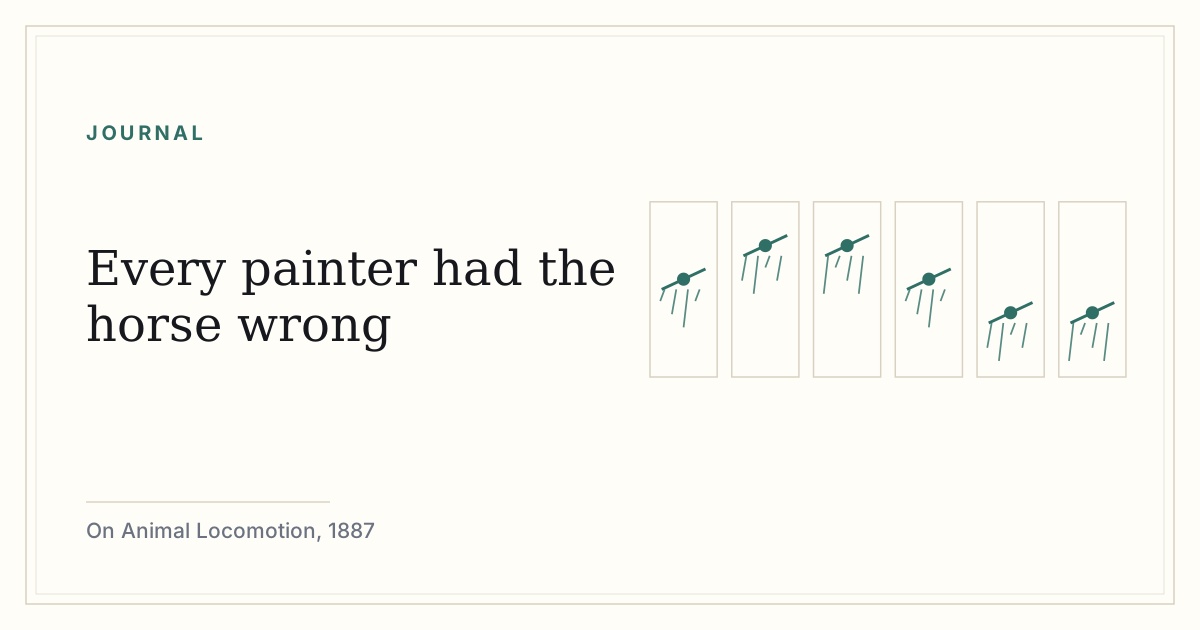
Before 1878, if you wanted to paint a galloping horse, you painted it stretched out like a hobby-horse: forelegs reaching forward, hind legs thrown back, belly low, all four hooves off the ground at full extension. This pose has a name — the flying gallop — and a very long pedigree. You can find it in Assyrian relief carving, in Chinese painting, on Greek pottery, in eighteenth-century English sporting art. Painters had been repeating it for thousands of years.
It does not happen. No horse has ever done it.
The horse does leave the ground, which was the narrow question actually under dispute. But it does so with its legs gathered underneath its body, in the fraction of the stride when the limbs are bunched rather than extended. The extended, splayed moment that every painter drew is precisely the moment when at least one hoof is planted. The convention was not a stylisation of something true. It was simply wrong, and nobody could tell, because the motion is far too fast for the eye to resolve.
The commission, and the bet that probably never happened
Leland Stanford — railroad money, former governor of California, serious breeder of trotting horses — engaged the photographer Eadweard Muybridge to settle the question with a camera. Muybridge had been born Edward James Muggeridge in Kingston upon Thames and had rebuilt both his name and his career in California, where he was already well known for large-format landscape work.
You will often read that Stanford made a $25,000 wager on the answer. There is no good evidence for it. The bet story appears later, gets repeated because it is a better anecdote than “a wealthy owner wanted to know how his horses moved,” and has been quietly abandoned by most historians who have looked for a primary source. We mention it because it is the single most repeated claim about this experiment and it is very likely false.
What is documented is the setup. On 15 June 1878, at Stanford’s Palo Alto stock farm, Muybridge lined up a bank of cameras along the track with their shutters triggered in sequence as the horse passed — trip wires stretched across the course, released by the wheels of the sulky and by the animal itself. The mare was called Sallie Gardner. The resulting sequence, published as cabinet cards under the title The Horse in Motion, showed the gait broken into discrete instants for the first time.
Two separate things, often conflated. First: unsupported transit is real — there is a moment with no hoof on the ground. Second, and more damaging to the painters: that moment does not look anything like the flying gallop. The first finding answered Stanford’s question. The second one rewrote animal art.
Then he had to make it move again
Having taken motion apart, Muybridge built a machine to put it back together. The zoopraxiscope, which he began showing around 1879, painted the sequential figures onto a glass disc and projected them in rapid succession so an audience saw the horse trot on a screen. It is one of the direct ancestors of projected cinema, and it was invented for what we would now call data visualisation: the fastest way to convince a room that the frames were right was to run them at speed and let the animal move.
The larger body of work came later. Between 1884 and 1887, backed by the University of Pennsylvania, Muybridge produced Animal Locomotion: 781 collotype plates of humans and animals walking, running, jumping, climbing, carrying, wrestling, descending stairs. It is exhaustive to the point of strangeness. The human subjects are often nude, frequently Muybridge himself, and the framing decisions of the period are visible in who was photographed doing what. It remains the reference body of work on the subject, and a great deal of twentieth-century animation was drawn with a copy of it open on the desk.
The part that is usually left out
In 1874, four years before the Palo Alto sequence, Muybridge shot and killed Harry Larkyns, his wife’s lover. He did not deny it. At trial the jury rejected an insanity defense and acquitted him anyway, on the reasoning that the killing was justifiable. He went back to work, and Stanford hired him afterwards.
We include this in the record because a collection that tidies it away is not describing the same person. It also sits oddly with the usual account of the work, which treats Muybridge as a pure technician of the eye. He was a difficult, litigious man — he later fought Stanford in court over credit for the horse photographs — and the instrument he built does not care about any of that. The plates are still true.
Why we keep the record
Muybridge is the clearest case in the collection of an instrument overruling consensus perception. Nobody was lying about the flying gallop. Thousands of careful observers, many of them people who spent their working lives around horses, had looked directly at the animal and drawn what they were certain they saw. The camera did not show them something new so much as show them that they had never been able to see it at all.
Étienne-Jules Marey, working in Paris on chronophotography, was after the same thing from a different direction, and the two men corresponded. Between them they established the principle that if a process is faster than perception, you do not argue about it — you sample it.
Sources and further reading
- Muybridge, Eadweard. Animal Locomotion: An Electro-Photographic Investigation of Consecutive Phases of Animal Movements. Philadelphia: University of Pennsylvania, 1887. 781 plates. See our collection record.
- Muybridge, Eadweard. The Horse in Motion, cabinet card series, 1878–1879.
- Marey, Étienne-Jules. Le Mouvement. Paris, 1894.
- On the disputed $25,000 wager: no contemporary documentation of a bet has been produced; the claim should be treated as unverified.
How we source and check these essays · Spotted an error? lumingrade@gmail.com